

Subrights, Foreign Rights & Translation Rights: Understanding the Differences
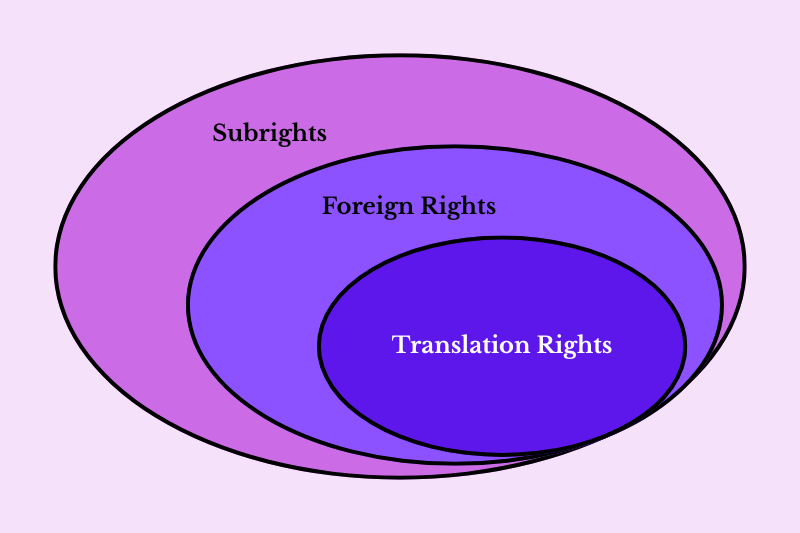
Confusing terminology in book publishing can contribute to gatekeeping and misunderstanding within the industry. It doesn’t help that oftentimes words, while having slightly different meanings, are used interchangeably. Even at Hellebore, terms such as “subrights,” “foreign rights,” and “translation rights” are not immune to conflation. So let me help break it down.
In book publishing, the term “subsidiary rights,” or “subrights,” refers to any permissions or licenses outside of the main print publication rights. The rights to audio, film/TV, merchandise, and digital are all types of subrights, but this list is not exhaustive. Any way your story can show up in the world lends itself to subrights.
Let’s say you are an author in the US whose book gets picked up by a US publisher. That publisher pays you for the rights to physically print your book in English in the US or all of North America—those are the main print publication rights.
If your contract gives the publisher “world rights,” they have the ability to negotiate subrights deals for you or handle production themselves. Audiobook and ebook creation, big-screen deals, and branded merchandise relating to your book (think along the lines of those Fourth Wing pins, bookmarks, and apparel you can’t escape at any bookstore these days) can all fall under this umbrella.
Foreign rights are also a form of subrights. Essentially, foreign rights encompass all the above-mentioned main rights and subrights, just in a different country. Let’s say your US publisher does hold world rights for your book. With their foreign rights team, they will reach out to publishers in other countries to try to sell them the right to print or otherwise bring to life your story.
Translation rights are technically a subsection of foreign rights because foreign rights deals don’t have to be in another language. If your US publisher sells the foreign rights to your book to a UK publisher, then it will still be in English; it won’t need to be translated. However, selling to a German or French publisher would require translation rights.
At Hellebore, we only deal with translation rights because our authors oftentimes have their books in English on Amazon, and Amazon does not allow the same version of books published on their platform—that is, the same story in the same language—to be published elsewhere. If you have never published with Amazon, we are open to doing deals with English-speaking countries, but we would never ask our authors to cut off a revenue stream.
All translation rights are foreign rights, and all foreign rights are subrights. But not all subrights are foreign rights, and not all foreign rights are translation rights. Hopefully this clears up some of the rights jargon confusion surrounding book publishing! ✿
